Internal wall removal on the Costa del Sol, including load-bearing walls with your engineer
Knocking down partitions and opening load-bearing walls to your engineer's design, with dust control and clean edges for the builder.
Interior demolition · provincia de Málaga
We carry out interior demolition in apartments, villas and commercial units across the provincia de Málaga: partitions and load-bearing walls with your engineer, kitchens, bathrooms, floors and ceilings. You can deal with us in English and follow the work through photos while you are away.

In short
Demolición Interior Málaga strips out the inside of a property so the renovation can start on a clean, sorted shell. Structural openings follow the documentation of your técnico, the community of owners is informed beforehand, and the rubble is sorted on site and delivered to an authorised waste manager with receipts for you.
Six types of interior work, each with its own page explaining how it is done, what has to be checked first and what you will be asked to send.
Knocking down partitions and opening load-bearing walls to your engineer's design, with dust control and clean edges for the builder.
Units, sanitary ware, wall and floor tiles and screed removed from kitchens and bathrooms, leaving a bare room ready for the fitter.
Shops, bars, restaurants and offices stripped back to shell condition at the end of a lease or before a new fit-out.
False ceilings, plaster ceilings, floor tiles, parquet and screeds removed so new installations and finishes can go in.
Manual demolition with hammers, breakers and cutters for interiors, flat roofs and tight spaces where machines cannot work.
Apartments and villas emptied to a clean shell in one sequence: fittings, kitchens, bathrooms, partitions, ceilings and floors.
Interior demolition is the controlled removal of everything inside a building that the renovation will replace, while the structure, façade and the neighbours' property stay untouched. In practice it covers partition walls, kitchens and bathrooms, wall and floor tiles, screeds, false ceilings, doors, built-in wardrobes and the old installations behind them.
The trade term is strip-out, and a soft strip is its lightest version: fittings, finishes and non-structural elements come out, nothing that carries load is touched. A full strip-out goes further and leaves the apartment or unit as a bare shell, ready for a new layout. Either way, the work is done mostly by hand or with small electric tools, because inside a flat or a shop there is no room for machines and every blow travels through the slab to the people living below.
On this site each type of work has its own page: full interior strip-out, wall removal, including load-bearing walls, kitchen and bathroom strip-out, floors and ceilings, commercial strip-out for shops, restaurants and offices, and hand demolition as a technique in its own right.
This site is written for people who own a property on the Costa del Sol but live elsewhere – in the United Kingdom, Ireland, Scandinavia, the Netherlands or Germany. Typically they bought an apartment in the 1970s or 1980s that now needs a new kitchen and an open layout, a villa where three small bedrooms should become two large ones, or a commercial unit that a new tenant wants empty. What they have in common is that they cannot stand on site every morning.
We also work for architects, interior designers and builders who prefer to hand the demolition stage to a specialist and start their own trades on a clean shell. In that case we follow their drawings and their calendar, and the owner simply receives the same photo record.
A strip-out can be run remotely if three things are settled before the first day: who holds the keys, who the community administrator is, and how you want to be informed. Once those are clear, you do not need to fly over for the demolition stage.
We start from the photos and measurements you or your agent send, and arrange a visit with whoever has access – a neighbour, a property manager, the concierge or your builder. After the visit you receive a written scope listing what will be removed and what stays, so there is no ambiguity about the built-in wardrobe you want to keep or the radiator that must survive.
During the work you get photos by WhatsApp or e-mail at the moments that matter: the protection of the lift and the stairwell, each wall before and after it comes down, the exposed pipes and cables, and the empty rooms at the end. Hidden surprises – a beam where nobody expected one, old fibre-cement pipes, damp in a slab – are reported with a picture before anyone decides what to do next. You can write to us in English or Spanish; documents from the town hall or the community stay in Spanish, but we explain what they say in plain English.
For owners whose project goes beyond the interior, our sister site explains how a whole demolition is managed from abroad, from paperwork to final clearance.
Yes, a load-bearing wall can often be opened or removed, but only with a design by a técnico competente that defines how the loads are carried once the wall has gone. That person calculates the new beam or frame, specifies the temporary propping and signs the technical documentation; we carry out the demolition part following that sequence and coordinate dates with whoever installs the new structural element.
Many walls in older Costa del Sol blocks are not what they look like. A thin brick wall can carry part of a slab above, while a thick one may be nothing more than an old service shaft. Before any quote for an opening we ask who has assessed the wall. Our guide on how to tell whether a wall is load-bearing lists the signs owners can check, and our blog post on red flags before anyone touches a load-bearing wall describes what should make you stop a contractor.
In a building under propiedad horizontal there is a second step. Under the Ley 49/1960 de Propiedad Horizontal the community has to be informed before walls, structure or façade elements are demolished, and works that affect common elements need the agreement of the owners' meeting. Structure is usually a common element, so the administrator should be involved early.
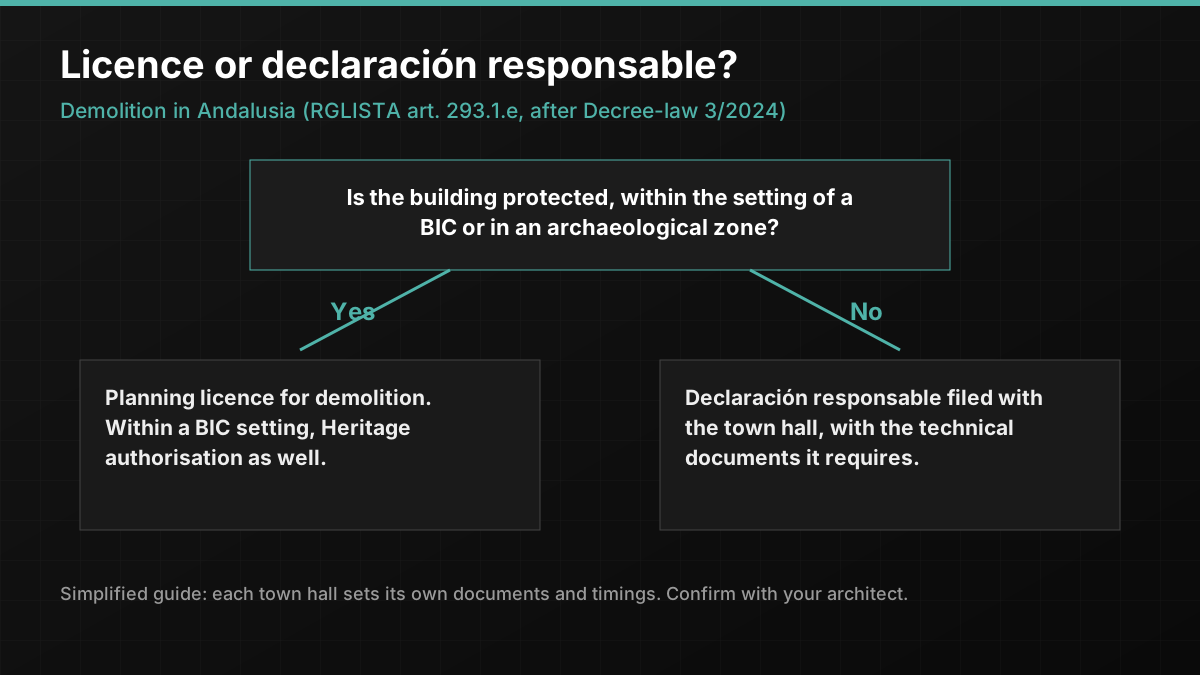
Whether you need a permit depends on what is being removed, where the building is and what the town hall's ordinance says, so the honest answer is: check before you start. In Andalusia the total or partial demolition of buildings is done by declaración responsable since the Decreto-ley 3/2024, unless the building is protected or lies in a protected setting, where a licencia urbanística is still needed. In Málaga city, the 2025 municipal licensing ordinance (OMLU) asks for a project or technical report signed by a técnico competente, a technical certificate and photographs for a works declaración responsable.
Each ayuntamiento – Marbella, Estepona, Mijas, Fuengirola, Benalmádena, Torremolinos and the rest – sets out its own documents and timings, so ask your técnico or the town hall which procedure applies to your works. If a skip, hoist or scaffold has to stand on the street, the occupation of the public road needs its own authorisation. We do not file declarations or obtain licences: that is done by the owner and their técnico. What we do is tell you what the town hall usually asks for, work from the documentation once it exists and adapt our dates to it.
The guide do you need a permit to remove an internal wall in Spain? goes through the situations one by one, and the network's pillar site explains the wider permit regime for demolitions in Andalusia.
Most interior demolition on the coast happens in apartment buildings, and the neighbours experience the job before you see the result. A well-run strip-out respects three things: the common areas, the working hours and the waste route.
Our guide to strip-outs in a community of owners explains what to send the administrator, and the one on noise, dust and working hours covers how disruption is kept down.
Getting debris out of an upper-floor apartment is often the slowest part of the job, and it is planned before the first wall comes down. Rubble is bagged in the room where it is produced, carried or lowered to street level and loaded out as the work goes, so bags do not pile up on the landing.
In buildings without a lift, or where the lift may not be used, bags go down by hand; on some façades a debris chute or a small hoist is possible if the community and, where needed, the town hall allow it. Where the street is narrow, as in many old town centres, loading is arranged around the times when a vehicle can stop. Our guide on getting rubble out of an apartment without a lift describes each option.
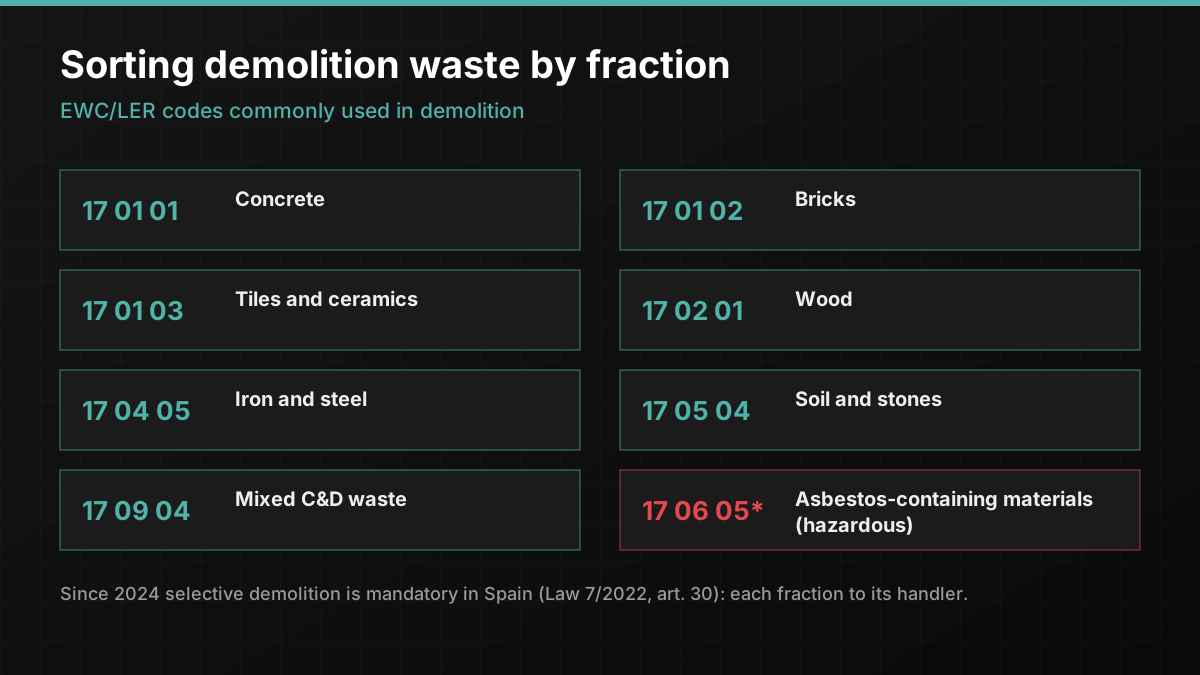
The waste itself is sorted as it is produced. Since 2022 the Ley 7/2022 on waste requires non-hazardous construction and demolition waste to be separated at least into wood, mineral fractions such as bricks, tiles and concrete, metals, glass, plastic and plaster, and selective demolition has been mandatory since 1 January 2024. On an interior job that means separate bags for ceramic rubble, plasterboard and gypsum, metal from old frames and pipes, and wood from doors and kitchen units. The sorted waste goes to an authorised waste manager and you receive the delivery receipts. For larger volumes – a whole building or a commercial unit with concrete floors – our sister site handles rubble removal and skips.
Asbestos is the one discovery that stops an interior demolition immediately. In buildings of the right age it can appear as fibre-cement (uralita) downpipes and flues inside walls, old water tanks on the roof or in a utility room, or panels in a service shaft. If something suspicious appears, work in that area stops and you receive a photo the same moment.
We do not remove asbestos ourselves. The removal is carried out by a company registered in the RERA that works as our subcontractor, under its own work plan approved by the labour authority, and the asbestos waste is kept apart from all other rubble and delivered to an authorised manager as hazardous waste. We coordinate the rest of the strip-out around it. The current regulation on asbestos work is the Real Decreto 847/2026, in force since late October 2026.
The guide hidden asbestos in interior renovations shows where it usually appears, and our sister site explains how asbestos removal is organised from start to finish.
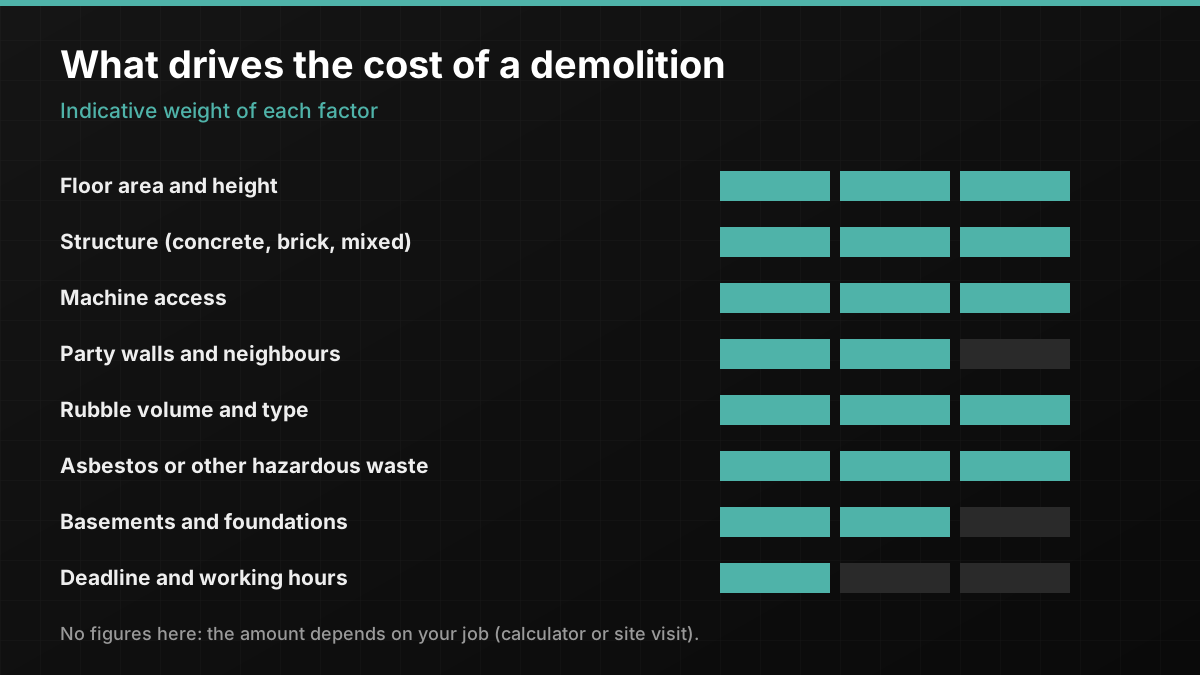
We do not publish prices, because two strip-outs of the same floor area can differ completely in effort. What drives the cost is known, though, and you can estimate it yourself before asking for a quote:
Demolition work generally carries the standard 21 % IVA; some renovation work on private homes may qualify for the reduced 10 % rate if the conditions of the VAT law are met, and each quote states which rate applies. For a rough idea before contacting anyone, the network's interior demolition cost page and its demolition calculator show how these factors add up. The blog post what affects the cost of an interior strip-out in Spain explains each factor in more depth.
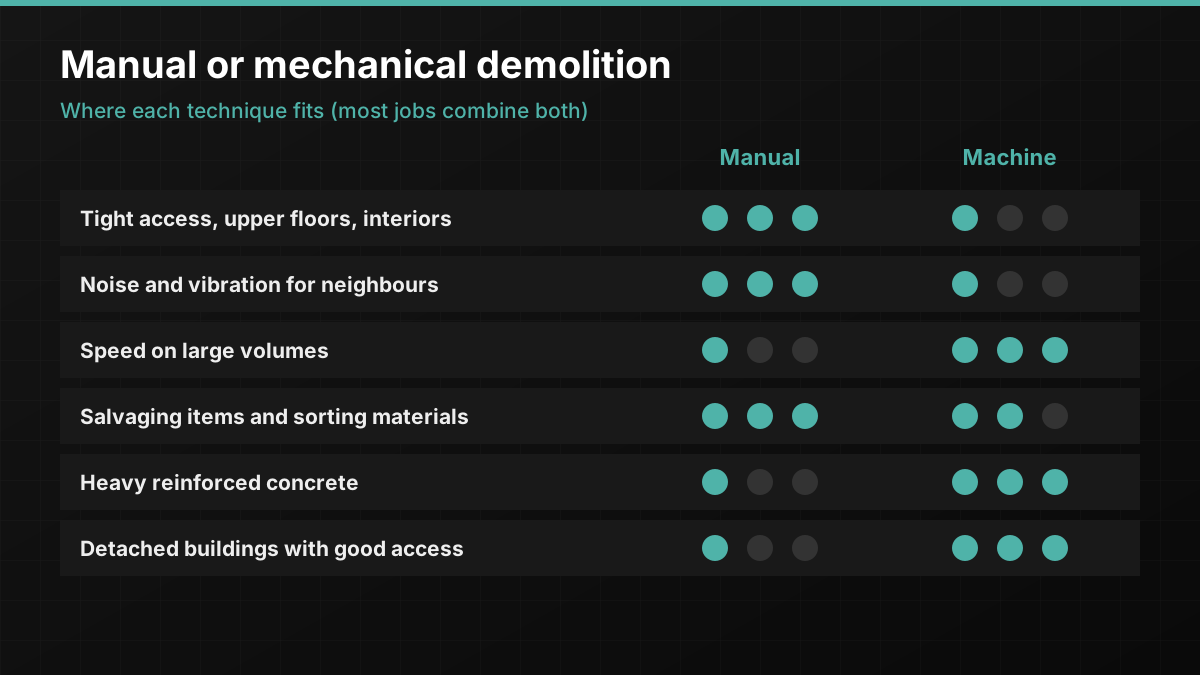
Inside an apartment almost everything is done by hand: sledgehammers, crowbars, electric demolition hammers and breakers, cutters for clean edges where a wall meets one that stays. Machines would overload the slab and shake the building. Hand demolition is slower, but it is precise, quiet compared with a breaker on a machine, and it lets materials be separated as they come off the wall.
In larger spaces – a ground-floor shop with a thick concrete floor, a basement, a villa where a whole wing is opened – compact equipment can make sense, and we will say so if it does. The comparison is laid out in the blog post hand demolition vs machine demolition indoors and in the guide hand demolition explained. When the job turns into demolishing a whole house rather than its interior, the right place is the network's pillar site for house and villa demolition.
We work across the whole provincia de Málaga. Most interior jobs are on the Costa del Sol – Marbella, Estepona, Mijas, Fuengirola, Benalmádena and Torremolinos – and on the eastern coast around Rincón de la Victoria, Vélez-Málaga and Nerja, with inland work in Ronda and Antequera. Our area pages describe what is typical in each: high-rise apartment blocks on the coast, townhouses in old centres with narrow streets, or villas in urbanizaciones where the access road decides how rubble is loaded.
Historic town centres need extra care. Málaga, Ronda, Vélez-Málaga, Antequera, Archidona and Casares have protected historic areas; in a protected conjunto histórico a demolition needs a licence and, where applicable, heritage authorisation, so confirm it with the town hall before planning dates.
Photos of each room, the address or municipality, the floor, whether there is a lift, and what should go and what should stay.
We visit with whoever has access and send a scope in English listing every element to be removed, with the conditions that affect the work.
Your técnico prepares any documentation the town hall or the structure requires; the administrator is informed and the timetable agreed.
Lift, landings and stairs are protected; the work proceeds room by room, with photos at each key stage.
Rubble is bagged by material, taken away and delivered to an authorised waste manager; you receive the receipts.
The space is swept and photographed so your builder can measure and start without clearing anything first.

An electric demolition hammer breaking the finishing layers of a flat roof on a tall building, with no machine loading the roof.
Three workers removing the layers of a flat roof manually, the same technique used inside apartments where machines cannot go.

A single-storey brick house with a tiled roof and porch, with a skip in place before work began.
The clues that suggest a wall carries load, why a técnico must confirm it, and what propping and a new beam involve.
Declaración responsable vs licence for wall removal in Andalusia, Málaga city specifics, protected centres and community consent.
When the community must be told, when the owners' meeting decides, and how to run a strip-out without falling out with the neighbours.
Scope, access, floor level, waste sorting and surprises behind the tiles: the factors that really move an interior strip-out quote.
What makes a strip-out quote look cheap, what a high one should justify, and the questions that make quotes comparable.
Water, drains, shared pipes, vague scopes and ordering too early: the avoidable errors in kitchen and bathroom strip-outs.
Our specialist sites
A soft strip removes fittings, finishes and non-structural items such as kitchen units, sanitary ware, false ceilings and floor coverings. A full strip-out also takes out partitions, screeds and old installations, leaving a bare shell ready for a new layout.
No. The work can be followed from abroad through photos and messages. Someone has to give access for the survey and the first day – a neighbour, agent, concierge or builder – and the keys can stay with that person.
Yes, you can write or call in English or Spanish. Quotes and scopes can be written in English; official documents remain in Spanish, and we explain what they mean.
We carry out the demolition of a load-bearing wall only when a técnico competente has designed how its loads will be carried and has specified the propping and the new structural element. Without that documentation we do not touch it.
No. We are a demolition contractor: the técnico prepares and signs the documentation and the owner files it with the town hall. We work from that documentation and tell you what the town hall usually asks for.
Under the Ley de Propiedad Horizontal the community must be informed before walls, structure or façade elements are demolished, and works affecting common elements need the agreement of the owners' meeting. Partition walls inside your own flat are a different case from structure; your administrator can tell you how your community handles it.
Before rubble leaves the flat, the lift car, landings and stair treads are covered with protection boards and sheeting. If the community does not allow the lift to be used, bags go down by the stairs.
Rubble is bagged in manageable sizes and carried down by hand, or lowered by a chute or hoist where the building and the authorities allow it. Bags are loaded out on the day they are filled so they never block the landing.
It is sorted on site into separate fractions such as ceramics, plaster, metal and wood, then delivered to an authorised waste manager. You receive the delivery receipts for your records.
Work stops in that area and you get a photo straight away. The removal is carried out by a RERA-registered company working as our subcontractor, under its own approved work plan, and we coordinate the rest of the job around it.
Yes. A kitchen or bathroom strip-out is a job on its own; the rest of the flat is closed off and protected, and the water and power to the room are isolated before work starts.
We need the room's supplies isolated before demolition. Disconnections and capping of gas and electrical circuits should be done by the relevant qualified installer; we coordinate the timing with them.
Breaking tiles and screed is loud, while removing ceilings, units and plasterboard is much quieter. We group the noisy work into the hours agreed with the community.
Yes. Commercial strip-outs are often done in buildings with residents above; the same rules on hours, dust and access apply, and the work is phased so the street entrance stays usable.
Photos of every room, approximate square metres, the address or municipality, the floor and whether there is a lift, what has to stay, and when the renovation should start.
The quote is based on the scope agreed in writing. If something hidden changes the work, such as a structural element or fibre-cement pipes, we report it with a photo and agree any change before continuing.
Demolition work generally carries the standard 21 % IVA. Some renovation work on private homes can qualify for 10 % if the VAT law conditions are met; each quote states the rate that applies.
For the municipal and tax procedures of the works, the owner identifies with their DNI, NIE or NIF. Your técnico or gestor can confirm what is needed for your particular procedure.
Yes, anywhere in the provincia de Málaga, including the Axarquía, the Guadalhorce valley, Antequera and the Serranía de Ronda.
Outside work such as pools, terraces and garden walls is handled by our sister site for pools and outdoor structures, so inside and outside work can be coordinated if your project needs both.
This form is sent straight to oficina@demolicioninteriormalaga.eu.
Send a few photos, the address and roughly what has to go. We reply in English with questions or a no-obligation quote.