In short
In older Spanish homes and commercial units, asbestos can appear in fibre-cement pipes, downpipes and ducts, water tanks, flue pipes, some old floor tiles and adhesives, and in insulation or boards around heating equipment. Only a laboratory analysis confirms it, and only a RERA-registered company may remove it, under a work plan approved by the labour authority. On our jobs that removal is carried out by a RERA-registered subcontractor while we coordinate the rest of the strip-out.
Contents
- Why asbestos matters in an interior strip-out
- Where asbestos can hide in a flat or villa
- Which buildings are most likely to contain it?
- How to recognise a suspect material
- What we do if a suspect material appears
- Who is allowed to remove asbestos?
- What happens to asbestos waste?
- Questions to ask before you plan the strip-out
- Planning, timing and what to tell your técnico
- Frequently asked questions
Why asbestos matters in an interior strip-out
Asbestos-containing materials are mostly harmless while they are intact and left alone. The risk comes when they are broken, cut, drilled or sanded, because that releases fibres into the air. An interior strip-out does exactly that to everything it touches, which is why the presence of asbestos has to be considered before the hammers start, not after.
In Spain, asbestos work is regulated by the Real Decreto 847/2026, published in the BOE on 23 October 2026 and in force since late October 2026. It repealed the previous regulation, Real Decreto 396/2006, which is no longer in force, and transposes the European directive on asbestos at work. Anything you read that still cites the 2006 decree as current is out of date.
Where asbestos can hide in a flat or villa
Asbestos was used in many building products, and some of them sit exactly where a kitchen, bathroom or full strip-out goes. Places worth checking in older properties:
| Location | Possible material | When you meet it |
|---|---|---|
| Ducts and shafts (patinillos) | Fibre-cement soil stacks, downpipes and ventilation ducts | Bathroom and kitchen strip-outs |
| Roof spaces, terraces, utility rooms | Fibre-cement water tanks and their lids | Renovation of installations, roof works |
| Boiler rooms, fireplaces, kitchens | Fibre-cement flue pipes, insulating boards | Replacing heating or extraction |
| Floors | Some old vinyl or thermoplastic tiles and dark bituminous adhesives | Floor removal down to screed |
| Pipework and heating equipment | Lagging or insulation around pipes and boilers | Removing old heating systems |
| Façade elements, planters, window sills | Fibre-cement panels and pieces | Terrace closures, façade-related works |
| Electrical installations | Old boards behind fuse panels | Rewiring, removal of old panels |
None of these is asbestos by definition. Many similar products were made without it, especially in more recent decades. The table is a list of places to look, not a diagnosis.
Which buildings are most likely to contain it?
The age of the building is the strongest indicator. Older apartment blocks, village houses and commercial units that kept their original installations are the most likely to contain asbestos products, particularly fibre-cement pipes and tanks. A building that was fully renovated recently may have had them removed, but partial renovations often left original pipes inside ducts or behind new tiling.
In community buildings, the shared installations are the usual suspects: vertical soil stacks and rainwater downpipes running through the flats. Because they are common elements, decisions about them belong to the community, as explained in our guide to strip-outs and community of owners rules.
Town halls also have a role. Under Ley 7/2022, they had to draw up a census of installations and sites with asbestos within one year of the law coming into force, with higher-risk public buildings to be dealt with first. That does not create a fixed deadline for private owners to remove asbestos from their homes.
How to recognise a suspect material
Fibre cement – the material many people still call uralita after a well-known brand – is the most common asbestos product in Spanish buildings. Typical signs of old fibre cement:
- grey, slightly porous surface, often with a fine fibrous texture at broken edges;
- pipes and tanks with thick walls and simple moulded joints;
- a dull sound when tapped, unlike plastic;
- age-related weathering, moss or crumbling at exposed edges.
Floor tiles and adhesives are harder to judge visually; dark, brittle adhesive under old small-format vinyl tiles is a reason for caution. In every case the only reliable answer is a laboratory analysis of a sample taken by someone who knows how to do it safely. Our sister site has a fuller visual guide on how to recognise uralita.
What we do if a suspect material appears
On our interior demolition and kitchen and bathroom strip-out jobs, the procedure when something suspicious is found is fixed:
- Stop work on that element and keep it intact; no breaking, cutting or drilling.
- Mark and isolate the area so that nobody disturbs it while the rest of the strip-out continues where safe.
- Inform the owner, with photos, and, in a community building, the administrator if the element is shared.
- Arrange for the material to be assessed and, if asbestos is confirmed or presumed, for its removal by a RERA-registered company.
- Re-plan the sequence so the remaining demolition around the element waits until it has been removed.
Ideally the check happens before the strip-out starts. If the property is old and has original pipes or tanks, ask for them to be looked at at the survey stage, so that the programme already accounts for it.
Who is allowed to remove asbestos?
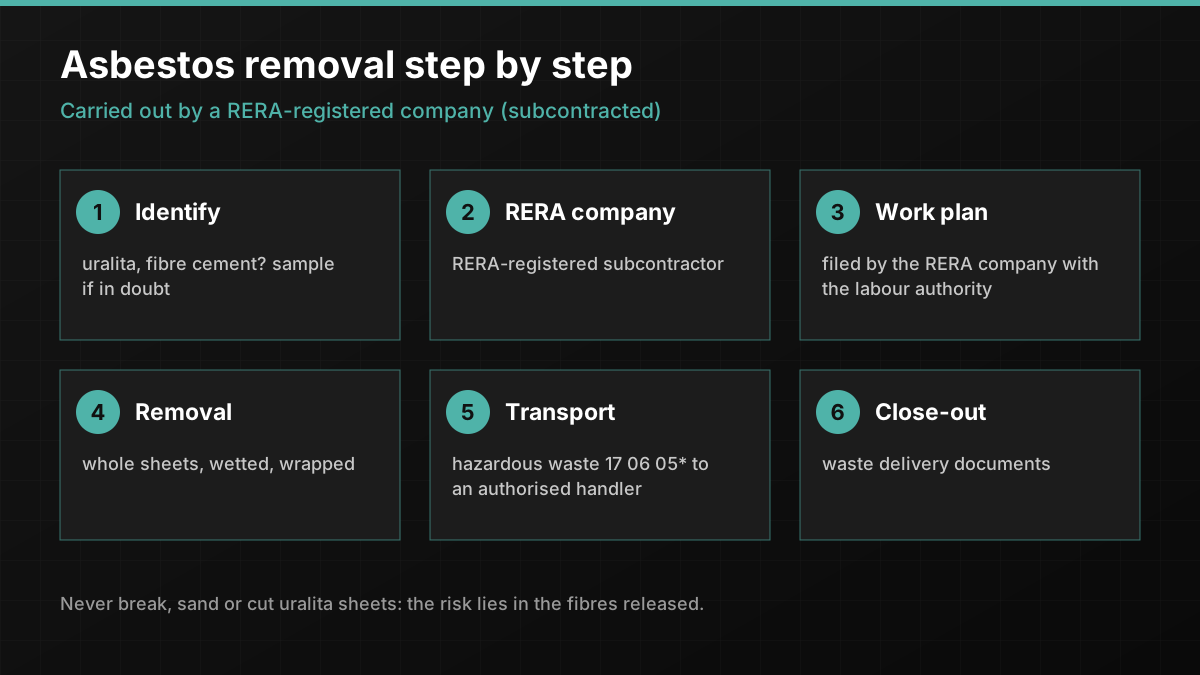
Only companies registered in the RERA, the Spanish register of companies working with asbestos risk, may demolish or remove materials containing asbestos, and only under a plan de trabajo approved by the labour authority of the province where the work is done. The start of the works is notified in advance. In Andalusia the RERA is kept by the Junta de Andalucía, and work plans are approved by the labour authority of each province.
Demolición Interior Málaga is not RERA-registered. The removal of asbestos is carried out by a RERA-registered company working as our subcontractor; that company prepares and files the work plan and carries out the removal, and we coordinate the rest of the demolition. This keeps the job in one set of hands for you while making sure the asbestos part is done by a company authorised for it.
For larger volumes, roofs or community-wide installations, our sister site covers asbestos removal as its own service.
What happens to asbestos waste?
Asbestos waste is hazardous and classified as 17 06 05* – construction materials containing asbestos. Under Ley 7/2022 art. 30.1, hazardous substances, especially asbestos, must be handled safely and never mixed with other waste.
In practice this means:
- asbestos materials are removed whole where possible, wrapped and labelled by the RERA company;
- they travel separately from the rest of the rubble and go to an authorised manager for this type of waste;
- the rest of the strip-out waste – ceramics, brick, gypsum, wood, metal – is sorted and handled normally, as described in getting rubble out of an apartment without a lift.
A suspect pipe thrown into a mixed skip contaminates the whole load. That is one more reason why the stop-and-check rule above is not optional.
Questions to ask before you plan the strip-out
A few questions, asked early, tell you whether asbestos is likely to be part of your project. They are useful whether you have just bought an older flat, inherited a village house or are taking over a commercial unit:
- Roughly when was the building built, and when were the kitchen, bathrooms and installations last renovated?
- Are the soil stacks, downpipes and ventilation ducts original, and what are they made of?
- Is there an old water tank on the roof, in a loft or in a utility room?
- Has the community already dealt with fibre-cement elements in common areas, or discussed it at a meeting?
- Are there old floor tiles under newer flooring, or old heating equipment with insulation?
- Did the seller, previous tenant or administrator mention uralita at any point?
Send us the answers with photos of ducts, tanks and floors, and we will tell you what we would want assessed before the strip-out starts. You can write to us in English.
Planning, timing and what to tell your técnico
Finding asbestos does not have to derail a renovation, but it does add a step. The RERA company needs its work plan approved before it can start, and the remaining demolition around the affected elements waits for that. Discovering it on day one is far better than on day ten.
Tell your técnico early if the property is old, has original pipes or tanks, or if the previous owner mentioned uralita. The técnico can include the issue in the project documentation and, if the works involve several companies, in the health and safety planning: under Real Decreto 1627/1997 the promotor appoints a safety coordinator during execution when several companies take part.
Cost questions follow the same logic as the rest of the job – volume, access, type of material – and are discussed with factors only; an indicative band for asbestos removal is available through the demolition cost calculator of our sister site. If the asbestos is in a shop or office, the same procedure applies inside a commercial strip-out.
Sources
Frequently asked questions
Where is asbestos found in Spanish apartments?
Most often in fibre-cement soil stacks, downpipes and ducts, water tanks and flue pipes; sometimes in old floor tiles and adhesives or in insulation around heating equipment. Only an analysis confirms it.
Is all uralita asbestos?
No. Uralita is a brand name commonly used for fibre cement, and older fibre-cement products often contained asbestos, but newer products were made without it. A laboratory analysis decides.
Can I remove a small asbestos pipe myself?
No. Only RERA-registered companies may remove asbestos-containing materials, under a work plan approved by the labour authority.
Are you RERA-registered?
No. Asbestos removal on our jobs is carried out by a RERA-registered company working as our subcontractor, which prepares the work plan and does the removal, while we coordinate the rest of the demolition.
Which law regulates asbestos work in Spain now?
Real Decreto 847/2026, in force since late October 2026. It repealed Real Decreto 396/2006, which is no longer in force.
What happens if asbestos is found during a strip-out?
Work on that element stops, the area is isolated, the owner is informed and removal is arranged with a RERA-registered company before the demolition around it continues.
Does asbestos go in the same skip as the rubble?
Never. Asbestos waste is hazardous (17 06 05*), must not be mixed with other waste and goes separately to an authorised manager.
Do I have to remove asbestos from my home by a certain date?
Spanish law does not set a fixed date for private owners. Town halls had to draw up a census of installations and sites with asbestos, with higher-risk public buildings dealt with first.
Who decides about asbestos pipes shared with the neighbours?
Shared soil stacks and downpipes are common installations, so the community of owners decides, usually through the administrator and the owners' meeting.
Should I test for asbestos before a renovation?
In older properties with original pipes, tanks or floor finishes, it is sensible to have suspect materials assessed before the strip-out starts, so that the programme already accounts for any removal.