
In short
A kitchen or bathroom strip-out removes units, worktops, sanitary ware, wall and floor tiles and, if needed, the screed underneath, after water, gas and power have been isolated. The room is left as bare walls and floor; rubble is sorted into ceramics, wood, metal and plaster and taken to an authorised waste manager.
Contents
- What does a kitchen strip-out include?
- Bathroom removal step by step
- How should old tiles be removed?
- Kitchen and bathroom strip-out in apartments
- If fibre-cement pipes or tanks appear
- Getting the rubble out
- Cost factors and planning
- Planning a kitchen or bathroom strip-out from abroad
- What to send for a quote
- Frequently asked questions
What does a kitchen strip-out include?
A kitchen strip-out removes everything that the new kitchen will replace: wall and base units, worktops, the sink, appliances, the extractor and its duct, wall tiles and, if the floor changes level or material, the floor tiles and their bed. What stays is agreed in writing beforehand – a boiler, a window, a radiator or the new owner's fridge.
Before we start, the water supply is shut and capped, gas is disconnected and capped by an authorised installer, and the kitchen's electrical circuits are isolated. Units are dismantled rather than smashed so that wood, metal and glass can be separated, and appliances leave the building whole.
Bathroom removal step by step
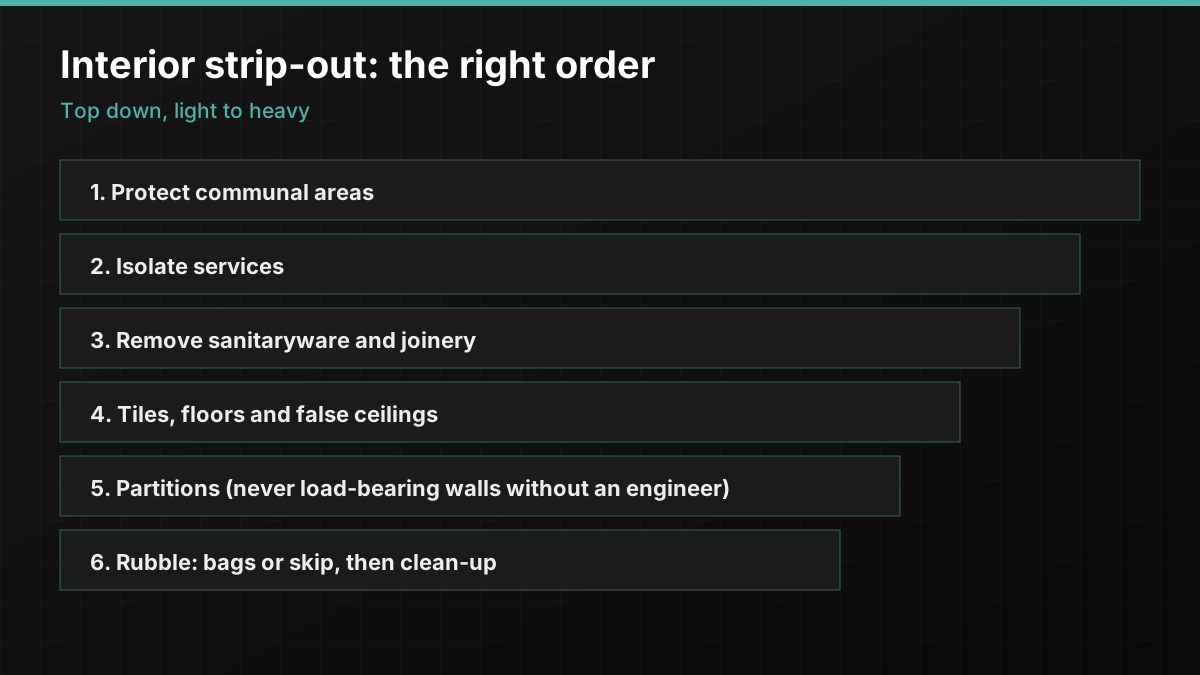
Bathroom removal follows a fixed order because the room is small and full of water connections:
- Water shut off, supply pipes and drainage capped.
- Mirror, cabinets, screens and accessories taken down.
- Toilet, bidet, basin and bath or shower tray removed; a steel or cast-iron bath may need to be broken or lifted out whole, depending on the door.
- Wall tiles taken off; if the new tiles need a flat base, the old render is removed too.
- Floor tiles and, if the plan requires it, the screed and old waterproofing down to the slab.
- Rubble bagged by material and the room swept clean.
The order protects the drains: they are capped before any rubble can fall into them, which saves a common and expensive problem for the plumber who comes next.
How should old tiles be removed?
How you remove old tiles depends on what they are stuck to. Tiles laid on modern adhesive over render often come away cleanly with a chisel or an electric hammer, leaving a surface that can be skimmed. Tiles laid the traditional way on a thick sand-and-cement bed take the bed with them, and the wall or floor underneath has to be rebuilt to level.
The tile removal process is therefore decided by the next trade. If the tiler wants to bond new tiles onto a sound old surface, we remove only the tile layer; if the floor needs underfloor heating or a level-access shower, we go down to the screed or the slab. For floor tile removal over large areas – a whole apartment rather than a bathroom – the page on floors and ceilings explains screed removal in more detail.
Kitchen and bathroom strip-out in apartments
In an apartment block the main constraints are the lift, the stairs and the neighbours. Kitchen units and baths are bulky; we check door widths and the lift size during the visit and decide what leaves whole and what is cut down in the flat. Common areas are protected before the first item leaves.
Drainage stacks and gas risers are often shared. We do not cut into shared pipes: if the renovation needs to move a connection on a common installation, your plumber and the community have to agree it first. Wet rooms also hide surprises – leaks that have soaked the slab, old fibre-cement pipes in the service shaft. Our blog post on mistakes owners make with kitchen and bathroom strip-outs lists the ones we see most often.
If fibre-cement pipes or tanks appear
In older buildings, bathroom and kitchen service shafts sometimes contain fibre-cement drainage pipes, flues or water tanks that may contain asbestos. When we see one, work in that area stops and you receive a photo. Removal is carried out by a RERA-registered company working as our subcontractor, under its own approved work plan, and the waste never mixes with ordinary rubble. Where it typically hides is described in the guide on hidden asbestos in interior renovations, and the network's asbestos site covers asbestos pipes and tanks.
Getting the rubble out
A bathroom produces far more rubble than owners expect, mostly ceramic tiles and mortar, which is heavy. It is bagged in sizes that one person can carry and loaded out before the end of each working day. Without a lift, or where the lift may not be used, it goes down by the stairs; the guide on getting rubble out of an apartment without a lift explains the alternatives.
Ceramics, plaster, wood from the units, metal from frames and pipes, and glass are kept apart, as the Ley 7/2022 requires for construction and demolition waste. The waste goes to an authorised waste manager, and you receive the delivery receipts.
Cost factors and planning
The price of a kitchen or bathroom strip-out depends on how deep the removal goes (tiles only, or tiles, render and screed), the bedding method of the old tiles, the size of baths and units, the floor and lift, and the volume of rubble. We quote after photos or a visit; to understand the factors beforehand, see the network's interior demolition cost page.
Many owners book the strip-out as part of a wider job. If walls are also coming down, combine it with wall removal; if the entire flat is being redone, a full interior strip-out avoids two separate rounds of protection and access.
Planning a kitchen or bathroom strip-out from abroad
For owners who are not in Spain, the risk with a wet room is the gap between demolition and the plumber. Once the old bathroom is out, capped pipes and an open floor should not wait for weeks, especially in a holiday let. We agree the end date with your builder or plumber before we start, send photos of the capped connections and the bare floor on the last day, and leave the keys wherever you decide, so the next trade can begin without anyone flying over.
What to send for a quote
- Photos of every wall and the floor of the kitchen or bathroom, plus the door and corridor.
- What should stay: boiler, radiators, windows, any unit you want to keep.
- Whether the new design needs the screed removed.
- The municipality, floor, lift and the community's working hours if you know them.
Frequently asked questions
How long does a bathroom strip-out take?
An average apartment bathroom is usually stripped to walls and floor in one to two days. Removing the screed or a heavy cast-iron bath adds time.
Do you remove the old kitchen units and appliances?
Yes, units, worktops, sinks, appliances and the extractor are removed and taken away. Anything you want to keep or donate is set aside if you tell us in advance.
Who disconnects the gas in the kitchen?
Gas must be disconnected and capped by an authorised gas installer. We coordinate the date so the kitchen is safe before demolition starts.
Can new tiles go over the old ones instead?
Sometimes, if the old tiles are sound, flat and well bonded, and the extra thickness does not cause problems at doors and fittings. Your tiler decides; if the old layer is loose or hollow it has to come off.
How are tiles removed from a sand-and-cement bed?
The tile and its bed are broken out together with an electric hammer, down to the wall or the slab. The surface is then rebuilt by the builder.
Will removing bathroom tiles damage the neighbour's side?
Tile removal on shared walls is done with lighter tools and attention to the wall's thickness. Partitions between flats are thin, so heavy breaking there is avoided.
Do you remove the screed under the floor tiles?
Only if the new floor needs it, for example for underfloor heating, a level-access shower or a change in floor height. Otherwise only the tiles come off.
What if there is a leak under the bathroom floor?
Once the floor is open, damp areas become visible. We photograph them and tell you, so your plumber can trace the leak before the new floor is laid.
Can you strip out a kitchen in a rented apartment between tenants?
Yes. The work is short and can be planned between tenancies; we need the keys, the community's hours and the contact of whoever manages the property.
Do I need a permit for a kitchen strip-out?
The procedure depends on what the works involve and on the town hall's ordinance. Check with your técnico or the ayuntamiento which procedure applies.