In short
Hand demolition means taking elements apart with hand tools and hand-held power tools – crowbars, sledgehammers, electric breakers, saws and drills – instead of large machines. It is used indoors, near elements that must be kept, in tight access and wherever selective dismantling is needed, which Spanish law has required since 2024. Demolición Interior Málaga uses it for partitions, kitchens, bathrooms, floors, ceilings and roof layers across the provincia de Málaga.

Contents
- What is hand demolition?
- The tools of the trade
- Personal protective equipment
- When is hand demolition the right choice?
- Demolition robots: the middle ground
- The working sequence of a manual strip-out
- Hand demolition and selective demolition rules
- Typical hand demolition jobs in homes and businesses
- Limits and risks of working by hand
- Frequently asked questions
What is hand demolition?
Hand demolition, also called manual demolition, is the controlled removal of building elements by workers using hand tools and hand-held power tools, piece by piece, usually from the top down and from the lightest elements to the heaviest. It is the opposite end of the scale from machine demolition, where an excavator with a breaker, shears or a grapple does the work from outside.
The aim is not only to take something down but to choose exactly where demolition stops. A tiled wall can be stripped to the brick without damaging the pipes behind it; a partition can be removed without cracking the ceiling; a roof's waterproofing layers can come off without touching the slab beneath. That precision is why it dominates interior work.
The tools of the trade
A hand demolition crew carries a small but varied toolkit, each item chosen for a specific kind of material:
| Tool | Typical use |
|---|---|
| Crowbars, pry bars, chisels | Lifting tiles, skirting, door frames, plasterboard and timber |
| Sledgehammers and lump hammers | Brick partitions and blockwork, in controlled blows |
| Electric demolition hammers and breakers | Tiles and screed, plaster, concrete in small sections, roof layers |
| Angle grinders and wall saws | Clean cuts where demolition must stop at a precise line |
| Diamond core drills | Openings for pipes and ducts without breaking the surroundings |
| Reciprocating saws | Timber, metal frames, pipes once isolated |
| Industrial vacuums and water sprayers | Dust control at the tool and in the room |
Our photo of an electric demolition hammer on a flat roof shows typical light breaker work: it is precise enough to remove layers while leaving the structure below intact.

Personal protective equipment
Hand demolition puts people close to the material, so protection is part of the method, not an extra. Each task is assessed in the contractor's health and safety plan, prepared from the job's estudio de seguridad y salud or estudio básico under Real Decreto 1627/1997. The standard kit for interior demolition includes:
- safety helmet where there is any risk of falling material;
- eye protection against chips and dust;
- respiratory protection suitable for fine construction dust;
- hearing protection for breakers and cutting;
- cut-resistant gloves and safety boots with protective toecaps and soles;
- anti-vibration practices for long breaker work: rotation of tasks and regular breaks.
Collective protection matters as much: guarding openings, propping where a técnico specifies it, keeping escape routes clear, and isolating electricity, water and gas in the work area before anything is cut.
When is hand demolition the right choice?
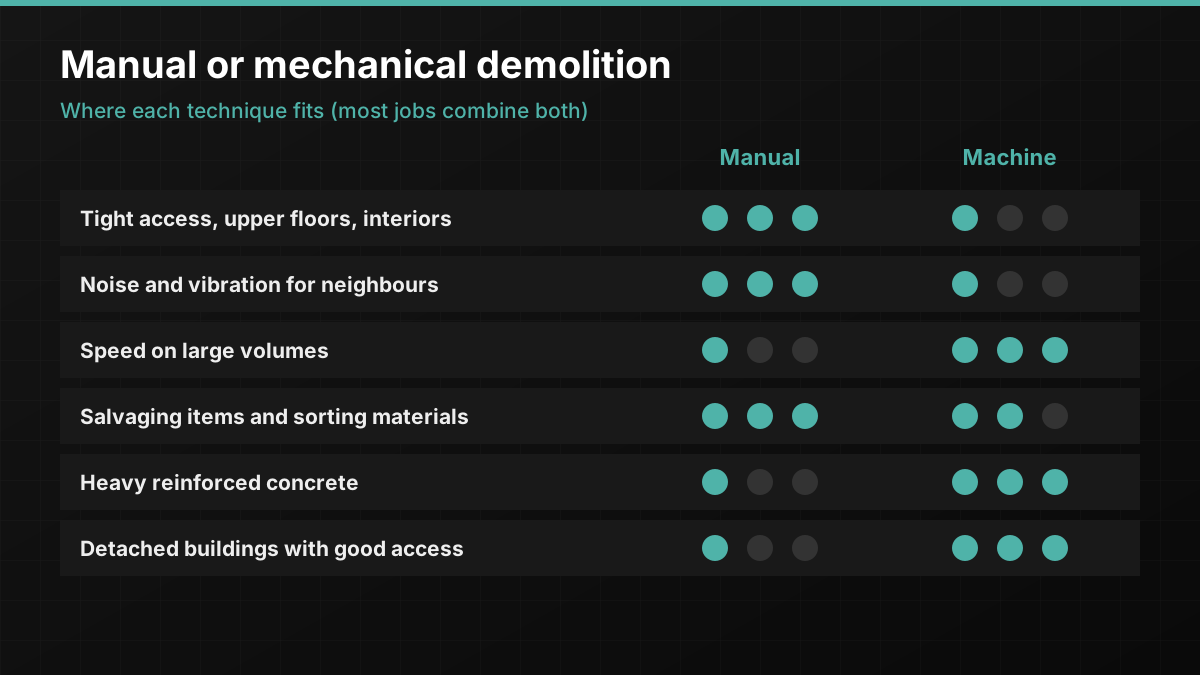
Hand demolition is slower per tonne than machinery, so it is chosen when its precision or its access advantages outweigh speed. The typical cases are:
- Interior strip-outs in flats, villas, shops and offices, where machines cannot enter and the structure stays. See our interior demolition service.
- Partial demolition next to elements that are kept: party walls, adjoining houses, the slab of a flat below.
- Floors, ceilings and roof layers that must be removed without damaging what lies beneath, covered by our floors and ceilings removal.
- Selective dismantling of reusable or recyclable elements before a larger demolition.
- Restricted access: narrow streets, historic centres, upper floors, inner courtyards.
- Around suspect materials: where materials might contain asbestos, everything else is dismantled carefully around them until the specialist company has dealt with them.
For a structured comparison of speed, noise and cost factors, read hand demolition vs machine demolition indoors.
Demolition robots: the middle ground
Between a crew with breakers and a full excavator there is a category of compact, remote-controlled demolition machines, often called demolition robots. The operator walks beside the machine with a remote control, and the arm carries a breaker, a crusher or a bucket.
They make sense for heavier interior work – thick masonry, concrete elements, long runs of screed – in ground floors, commercial units and buildings being emptied. Their use depends on two things that must be checked first: whether the slab can carry the machine's weight, and whether it can physically get in. In a typical apartment both conditions are hard to meet, which is why hand tools remain the norm in flats.
When an entire building, a warehouse or heavy concrete has to come down, it is a job for full-size machines; our sister site explains machine demolition for those cases.
The working sequence of a manual strip-out
Good hand demolition follows an order that keeps the site safe and the waste sorted. A typical sequence on our hand demolition jobs:
- Survey and isolation: check services, identify suspect materials, confirm with the técnico anything structural.
- Protection: floors, elements that stay, the rubble route and common areas.
- Soft strip: doors, furniture, kitchen units, sanitary ware, fittings, light fixtures.
- Linings and ceilings: plasterboard, false ceilings, timber cladding.
- Finishes: wall tiles, plaster, floor tiles and screed.
- Partitions: brick or block walls, from the top down, never undermined.
- Clearance: sorting by material, removal of rubble, cleaning, handover photos.
This order follows the logic of selective demolition: each material is removed in its own phase, which makes sorting almost automatic.
Hand demolition and selective demolition rules
In Spain, the Ley 7/2022 on waste states that demolition should preferably be selective, and selective demolition has been mandatory since 1 January 2024. Non-hazardous construction and demolition waste has to be sorted at least into wood, mineral fractions (concrete, bricks, tiles, ceramics, stone), metals, glass, plastic and gypsum, and reusable elements set aside.
Hand demolition fits this almost naturally, because elements come apart one by one. A machine can also demolish selectively when the building is first stripped by hand, which is why many larger demolitions start with a manual soft strip. Asbestos-containing materials are a separate case: they must never be mixed with other waste and are handled only by a RERA-registered company.
Typical hand demolition jobs in homes and businesses
Most of what we do by hand falls into a handful of recurring jobs, each with its own rhythm and its own critical point:
Bathroom strip-out
Sanitary ware, wall tiles, floor tiles and screed, sometimes the shower tray base. The critical point is the floor: the waterproofing and the slab below must not be damaged, and the shared soil stack must not be disturbed. Our photo of tile removal with a sledgehammer is a stock image, used here only to illustrate the technique.
Kitchen strip-out
Units, worktops, appliances, tiles and often a partition towards the living room. The critical points are isolated gas and water, and the wall that may be opened afterwards, which is checked by the técnico first.
Full apartment strip-out
Everything back to the structure and the external walls: doors, floors, ceilings, partitions, installations. The critical point is logistics – the rubble route and the sequence that keeps the flat safe while it is empty.
Roof layers on a flat roof
Tiles, screeds, insulation and waterproofing removed down to the slab before a new roof build-up is laid. The critical points are edge protection, weather and not overloading the roof with stockpiled rubble.
Shops and offices
False ceilings, raised floors, partitions and fit-out removed to return a unit to its shell. Here hand demolition is often combined with heavier equipment at ground level.
Limits and risks of working by hand
Hand demolition is not automatically the safer option. Its main risks are well known and planned for:
- Structural surprises: a wall that carries more than expected, a lintel hidden in a partition. The answer is a técnico's input before anything structural and stopping when the site does not match the drawings.
- Manual handling: lifting and carrying heavy material, especially on stairs; managed with bag sizes, rotation and mechanical aids where possible.
- Dust and noise: controlled at source and with protective equipment.
- Hidden services: live cables and pipes in walls and floors; services are isolated by the installer and checked before cutting.
Never undermine a wall from the bottom or pull it over in one piece indoors; walls come down from the top in small sections. That single rule prevents most of the accidents associated with amateur knock-throughs. The second rule is just as simple: when what you uncover does not match what you expected – a steel lintel, a hidden column, an unknown pipe – work on that element stops until it has been checked.
Sources
Frequently asked questions
What is manual demolition?
It is the removal of building elements with hand tools and hand-held power tools, piece by piece, instead of large machines. It is the standard method for interior work.
What tools are used for hand demolition?
Crowbars, chisels, sledgehammers, electric demolition hammers and breakers, angle grinders, wall saws, core drills and reciprocating saws, plus vacuums and water for dust control.
Is hand demolition slower than machine demolition?
Per tonne, yes. It is chosen when precision, access or the protection of what stays matters more than speed.
When is a demolition robot used?
For heavier interior work in ground floors, commercial units or buildings being emptied, provided the slab can carry the machine and it can get in. In most flats it is not practical.
What protective equipment do workers wear?
Helmet where needed, eye, respiratory and hearing protection, gloves and safety boots, with collective protection such as guarded openings and isolated services.
Is hand demolition required by law?
No specific method is required, but selective demolition has been mandatory in Spain since 1 January 2024, and hand demolition is the most natural way to achieve it indoors.
Can you remove a load-bearing wall by hand?
Yes, when an architect or engineer has designed the propping and the new support. We work from their documentation and never decide on structure ourselves.
Does hand demolition make less noise?
It produces short, local noise and transmits far less vibration through the building than heavy breakers, which is why it suits occupied apartment blocks.
What is engineered deconstruction?
It is a term for planned, selective dismantling in a defined order, often to recover materials or protect what stays. Interior hand demolition follows the same principle on a smaller scale.
Can hand demolition remove roof layers without damaging the slab?
Yes. Light electric breakers and hand tools remove tiles, screeds and waterproofing in layers while the structural slab is kept.