In short
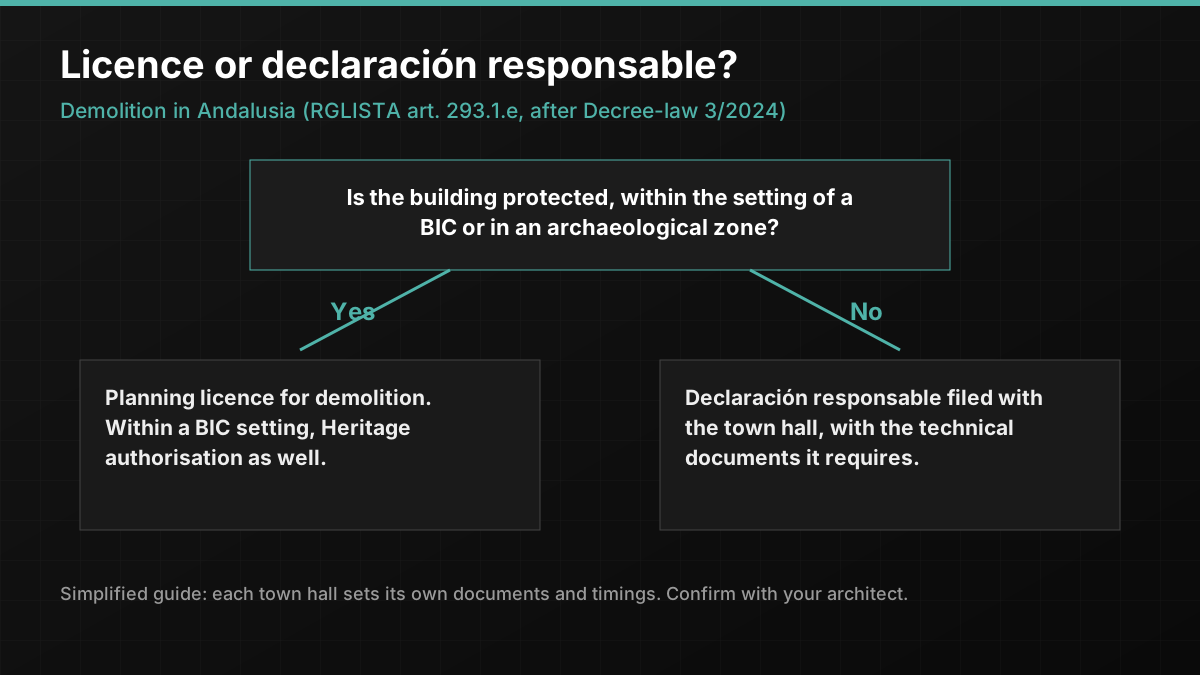
In Andalusia, total or partial demolition is normally carried out through a declaración responsable filed with the town hall, while buildings that are protected, in a protected setting or in an archaeological zone still need a licencia urbanística. Each town hall sets the documents in its ordinance, so the owner and their técnico confirm the procedure before work starts. Demolición Interior Málaga carries out the work but does not file the paperwork.
Contents
- The short answer for Andalusia
- When is a licence still required?
- Load-bearing or partition: why it changes the paperwork
- What Málaga city asks for
- Marbella, Mijas, Estepona and other towns
- Community of owners: a separate permission
- Who files what, and what we do
- Typical situations and how they usually play out
- Waste rules that come with any wall removal
- Frequently asked questions
The short answer for Andalusia
Removing an internal wall is almost never "no paperwork at all". In Andalusia the planning framework is the Ley 7/2021 (LISTA) and its general regulation, the Decreto 550/2022 (RGLISTA). Since the simplification decree Decreto-ley 3/2024, the total or partial demolition of buildings or constructions is done by declaración responsable (RGLISTA art. 293.1.e), provided the building is not under heritage protection or inside a protected setting.
A declaración responsable is a formal statement, filed with the town hall, that the works comply with the rules and that the required documentation exists. It replaces waiting for a licence in most cases, but it does not replace the documentation itself. Before 2024 the general rule for demolitions was the licence, which is why older advice found online can be misleading.
When is a licence still required?
The declaración responsable does not apply everywhere. A licencia urbanística is still required for the demolition of:
- buildings with heritage protection;
- buildings inside a protected setting (entorno) of a monument;
- buildings in archaeological zones.
This matters on the Costa del Sol more than people expect, because several towns have historic centres declared as Conjuntos Históricos. In Málaga, the Centro Histórico is a BIC, and any total or partial demolition there needs prior authorisation from the regional department responsible for historic heritage. Ronda, Vélez-Málaga, Antequera, Archidona and Casares also have declared historic centres. In a protected historic centre the demolition needs a licence and, where applicable, heritage authorisation; confirm it with the town hall.
Load-bearing or partition: why it changes the paperwork
A tabique that only divides two rooms and a wall that carries the floor above are very different jobs on paper. For a structural wall your técnico prepares documentation that describes the propping, the new support and the sequence, and that documentation is what the town hall procedure relies on. For a simple partition the documentation is lighter, but it still depends on the municipal ordinance.
If you are not sure which type you have, start with how to tell if a wall is load-bearing. We remove load-bearing walls only on the basis of an architect's or engineer's design, never on our own judgement.
The same logic applies to related work. A kitchen or bathroom strip-out that keeps the layout is a different scale of intervention from a knock-through that merges kitchen and living room; the second is more likely to involve a técnico and structural checks.
What Málaga city asks for
Málaga city (Gerencia Municipal de Urbanismo, GMU) approved a new Ordenanza Municipal de Licencias Urbanísticas (OMLU), published in the BOP de Málaga on 30 December 2025 and in force since the following day. Its Annex I.1, item 2, "Demoliciones totales o parciales de edificaciones", sets the declaración responsable for urban land, rustic land and SAFO, and the licence for protected buildings, protected settings and archaeological zones.
For a declaración responsable for works, Annex II.8 asks for:
- a proyecto or memoria técnica signed by a técnico competente, together with a certificado técnico;
- a separate document if the works will occupy the public road (for example with a skip or scaffolding);
- photographs.
Where a licence for partial demolition is needed, the file includes a nota simple from the Land Registry less than three months old, and an estudio de seguridad y salud applies where a project under the building law (LOE) is involved.
Marbella, Mijas, Estepona and other towns
Outside Málaga city, each town hall concretes documents and deadlines in its own ordinance; consult it with your técnico or with the ayuntamiento. A few points are confirmed:
- Mijas has an official declaración responsable for works citing RGLISTA art. 293.1, and works affecting the public road need prior authorisation.
- Benalmádena does not allow the public road to be occupied with skips or materials without a permit.
- Marbella has a declaración responsable procedure for works; whether demolition is included in it is still to be verified.
For an overview of how the coastal towns differ for larger demolitions, our sister site has a guide on demolition rules in Marbella, Estepona, Mijas and other towns.
A safe working rule: before starting, check with the town hall which procedure applies (declaración responsable or licence) and, if a skip or scaffolding will stand in the street, get the authorisation to occupy the public road.
Community of owners: a separate permission
A town hall procedure does not replace the community's consent. Under the Ley 49/1960 de Propiedad Horizontal, the community must be informed before walls, structure or façade elements are demolished in a building under horizontal property, and works affecting common elements need the agreement of the owners' meeting.
In practice, an internal partition inside your flat usually only requires notice, while anything touching the structure, the façade, shared ducts or the roof brings in the meeting. Our guide to community of owners rules for a strip-out explains how to prepare it, especially if you manage the flat from abroad.
Who files what, and what we do
Responsibilities are split clearly, and it is worth knowing who does what before anyone gives you a date:
| Task | Who |
|---|---|
| Decide the procedure and prepare the technical documentation | Your técnico competente |
| File the declaración responsable or apply for the licence | The owner (promotor), usually through the técnico |
| Public road occupation permit for a skip | Requested before the skip arrives; the owner or their técnico confirms who handles it |
| Community notice or meeting agreement | The owner, via the administrator |
| Demolition, sorting and removal of rubble | Demolición Interior Málaga |
| Waste delivery receipts | We hand them to you after delivery to an authorised manager |
For the owner's identification in municipal and tax procedures for the works, you use your DNI, NIE or NIF. We work with your técnico's documentation and coordinate dates with them; we do not file declarations, sign technical reports or obtain licences. When the paperwork is ready, the job itself is described on our wall removal and interior demolition pages.
Typical situations and how they usually play out
Owners rarely ask about walls in the abstract; they ask about a specific plan. These are the cases we see most often and the questions each one raises.
Opening the kitchen to the living room in a flat
The classic kitchen-diner knock-through. If the dividing wall is a brick partition in a concrete-frame block, the job is usually straightforward once the town hall procedure and the community notice are in place. If a column sits inside the wall, it stays, and the design has to work around it. If the wall turns out to be structural, the project changes category: técnico, propping, beam and owners' meeting.
Merging two bedrooms or enlarging a bathroom
Usually partitions only, but bathrooms bring shared soil stacks and ducts into play. Moving a bathroom away from the shared stack is a plumbing question for your técnico and installer as much as a demolition question.
Removing walls in an older townhouse or village house
Here thick walls are often load-bearing masonry, and some town centres are protected. Expect a técnico from the start and, in a historic centre, the licence regime.
Renovating a villa before selling or letting
Detached houses avoid the community question, but not the town hall procedure. If the house is near a protected monument or in a catalogued area, check the protection status before anything else.
Waste rules that come with any wall removal
Even a small knock-through produces construction and demolition waste, and the rules on it are national. Under the Ley 7/2022 on waste, non-hazardous demolition waste has to be sorted at least into wood, mineral fractions (concrete, bricks, tiles, ceramics, stone), metals, glass, plastic and gypsum, and selective demolition has been mandatory since 1 January 2024. If any material containing asbestos turns up, it must never be mixed with the rest.
The town hall requires a fianza or guarantee for construction waste; the amount depends on the municipal ordinance and it is returned when delivery to an authorised manager is proven. That is why the delivery receipts we hand over matter: they are the document that closes this loop. Waste from minor repair works in a home counts as household waste, which your técnico or town hall can confirm for your case.
Sources
Frequently asked questions
Do I need a permit to knock down a wall in Spain?
In Andalusia, total or partial demolition is normally done by declaración responsable filed with the town hall, and protected buildings need a licence. How your specific wall is classified depends on the town hall's ordinance, so confirm it before starting.
What is a declaración responsable?
It is a formal statement filed with the town hall that the works comply with the rules and that the required documentation exists. It lets work start without waiting for a licence, but the documentation still has to be prepared.
Did the rules change in 2024?
Yes. Since Decreto-ley 3/2024, total or partial demolition in Andalusia is done by declaración responsable unless the building is protected; before 2024 the general rule for demolitions was the licence.
Do I need a permit to remove a load-bearing wall in Spain?
A load-bearing wall requires a técnico's design and documentation, and the town hall procedure applies as for any partial demolition. In a community building the owners' meeting must also agree, because structure is a common element.
Do I need a permit to strip out a kitchen in Spain?
It depends on how the town hall classifies the work; replacing units and tiles without touching walls is a smaller intervention than a knock-through. Ask your técnico or the ayuntamiento which procedure applies.
What about Málaga's historic centre?
The Centro Histórico of Málaga is a BIC, and any total or partial demolition there needs prior authorisation from the regional heritage department, in addition to the municipal licence regime for protected areas.
Can you file the declaración responsable for me?
No. The owner files it, usually through their técnico, who prepares the documentation. We carry out the demolition and coordinate dates with your técnico.
Is a NIE required to apply?
For municipal and tax procedures for the works, the owner identifies themselves with their DNI, NIE or NIF. Your técnico or the town hall will tell you which document they need in your case.
Do I need a permit for a skip outside the building?
Yes, if it stands on the public road. Towns such as Benalmádena and Mijas require prior authorisation to occupy the street with skips or materials.
Can I knock down a wall myself in Spain?
The paperwork and community rules apply whoever does the work, and the waste must still be sorted and delivered to an authorised manager. For any wall that might be structural, a técnico must be involved regardless of who swings the hammer.