In short
The best way to strip out an apartment you rarely visit is to fix the scope in writing before work starts, settle keys and access with one trusted person, inform the community of owners early, agree photo updates at each stage and insist on waste delivery receipts. The worst way is to start with a vague brief and try to manage changes remotely as they come up.

Contents
- What makes a remote strip-out different?
- Best way: fix the scope as a finished state
- Worst way: a vague brief and decisions by phone
- How should keys, access and the community be handled?
- How should updates and checks work?
- Best way: plan waste and the next trades together
- Worst way: leaving the property half-protected
- Where can you get help beyond the strip-out?
- Frequently asked questions
What makes a remote strip-out different?
A remote strip-out is the same physical job as any other, but every decision that normally happens informally on site has to happen in advance or in writing. Nobody can pop in to say "keep that door" or "that tile under the sink can stay". The owner is also not there to talk to the neighbour downstairs, to collect a notice from the administrator or to let in the plumber.
That is why the best remote projects feel slow at the beginning and fast later. The questions are answered before the first bag of rubble is filled. Our interior demolition service is set up for owners who manage from abroad, in English, by WhatsApp and e-mail.
Best way: fix the scope as a finished state
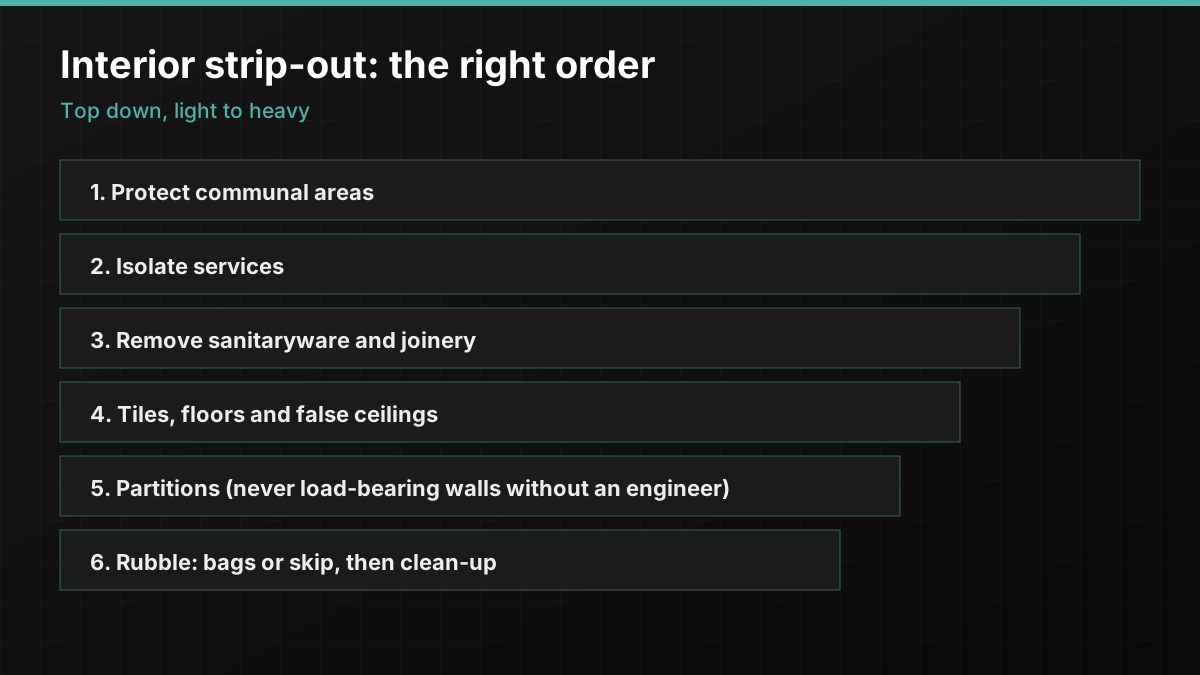
The strongest single step is to describe the result you expect, room by room, rather than a list of things to "remove". For example: "kitchen back to brick on all walls, floor tiles lifted to the slab, false ceiling removed, all units and appliances out; bathroom fully stripped including screed and old pipes up to the riser; living room parquet lifted, skirting removed, walls untouched".
A finished-state description leaves little to interpretation and makes it easy to check the result from photos. It also lets the contractor price accurately and tell you in advance about points that need your decision, such as a floor that might be laid over an older one. For floors and ceilings in particular, see floors and ceilings removal.
Worst way: a vague brief and decisions by phone
The least successful pattern we see is the brief that says "strip it all out, we will decide the rest later". Halfway through, the crew finds something unexpected, the owner is at work in another time zone, and the job either stops or continues on a guess. Both are expensive.
Closely related is the habit of adding "while you are there" items by message: an extra wall, a terrace floor, a wardrobe in another room. Each one may be small, but together they change the waste volume, the timing and the coordination with the next trades. Collect changes, agree them in writing, and keep one up-to-date scope document.
How should keys, access and the community be handled?
Decide early who holds the keys and who opens the door on the first day. A single trusted person, whether a property manager, a neighbour or a friend, is better than several people with partial information. Tell the contractor who that person is and what they are allowed to decide.
Inform the community of owners through the administrator before work starts. Under Ley 49/1960 the community must be informed before walls, structure or façade elements are demolished, and works affecting common elements need the owners' meeting agreement. Ask about lift use, protection of common areas, working hours and where a container can stand. If the container needs to be on the street, it has to be checked with the ayuntamiento whether a permit for occupying the public road is required. The guide on community of owners rules lists the usual questions.
For municipal and tax formalities of the works, the owner identifies themselves with their DNI, NIE or NIF; your técnico or the ayuntamiento will tell you what the procedure for your job requires.
How should updates and checks work?
Agree before starting how you will be kept informed. For most owners the most useful rhythm is a set of photos at the key points: protection installed, each room stripped, waste loaded, the final clean state. Photos taken from the same corners each time make progress easy to follow.
Ask for a short written note with each set of photos explaining what was done and anything that needs your decision. If something unexpected appears, such as a pipe, a damaged slab or a material that may contain asbestos, you want a photo, a clear explanation of the options and time to decide, rather than a phone call asking for an instant answer.
Best way: plan waste and the next trades together
Rubble handling is where remote owners lose the most control, because they never see where it goes. Insist that the waste is sorted, delivered to an authorised facility and that you receive the delivery receipts. Those receipts are also what the ayuntamiento looks for when it returns a waste deposit, if one was required.
Plan the next trades at the same time. A stripped apartment left empty for months collects dust, attracts damp and looks abandoned. If your builder, plumber or kitchen installer can measure and start shortly after the strip-out, you save time and avoid a second round of cleaning. We coordinate dates with your técnico and installers so the hand-over is clean. For bathrooms and kitchens, the kitchen and bathroom strip-out page explains what condition we leave rooms in for the next trade.
Worst way: leaving the property half-protected
Another common mistake is to leave belongings, furniture and electronics in the apartment with a few sheets over them. Interior demolition dust is fine and travels into wardrobes, drawers and air-conditioning units. If something must stay, it should be in a sealed room or properly wrapped, and the contractor should know which room is off-limits.
Before you leave Spain, or before the contractor starts, arrange for the property to be emptied of what matters to you. Removing furniture is a preparation task you can organise yourself or with a removals company; it shortens the strip-out and removes any doubt about what stays.
Where can you get help beyond the strip-out?
If your plans go further than an interior strip-out, for example demolishing an outbuilding or an entire villa, our sister site demolicionesmalaga.eu explains how it organises demolition managed from abroad. For the interior part, our post on what a strip-out with us looks like, day by day shows the sequence in practice, and our contact page lists what to send for a first assessment.
Frequently asked questions
Do I need to be in Spain during the strip-out?
No. With a written scope, a key holder and agreed photo updates, the job can run while you are abroad.
Can I communicate with you in English?
Yes. You can write to us in English by WhatsApp or e-mail, and we send updates in English.
Who should hold the keys?
One trusted person, such as a property manager or neighbour, who knows what they may decide on your behalf. Tell us who it is before we start.
How will I know the work is going well?
We agree a set of photos at the key stages, taken from the same points, with a short note on what was done and anything that needs your decision.
Do I need to inform the community before a strip-out?
Yes, through the administrator. Under Ley 49/1960 the community must be informed before walls, structure or façade elements are demolished, and works on common elements need the owners' meeting agreement.
Do I need a NIE for the works?
For municipal and tax formalities of the works the owner identifies themselves with their DNI, NIE or NIF. Your técnico or the ayuntamiento confirms what your procedure needs.
What happens if you find something unexpected?
We stop that part of the work, send photos and explain the options, and wait for your decision. Asbestos is handled by a RERA-registered subcontractor.
Can you coordinate with my builder or kitchen installer?
Yes. We agree dates and the finished state with them so the next trade can start soon after the strip-out.
Should I leave furniture in the apartment?
Preferably not. Fine dust travels everywhere; if something must stay, it should be in a sealed room we know about.
How do I know the rubble was disposed of legally?
You receive the delivery receipts from the authorised waste facility. Keep them, as they may be needed to recover a municipal waste deposit.